Netix AI network assistant (Orange)
Applied AI engineer, Orange (2026), five-person team
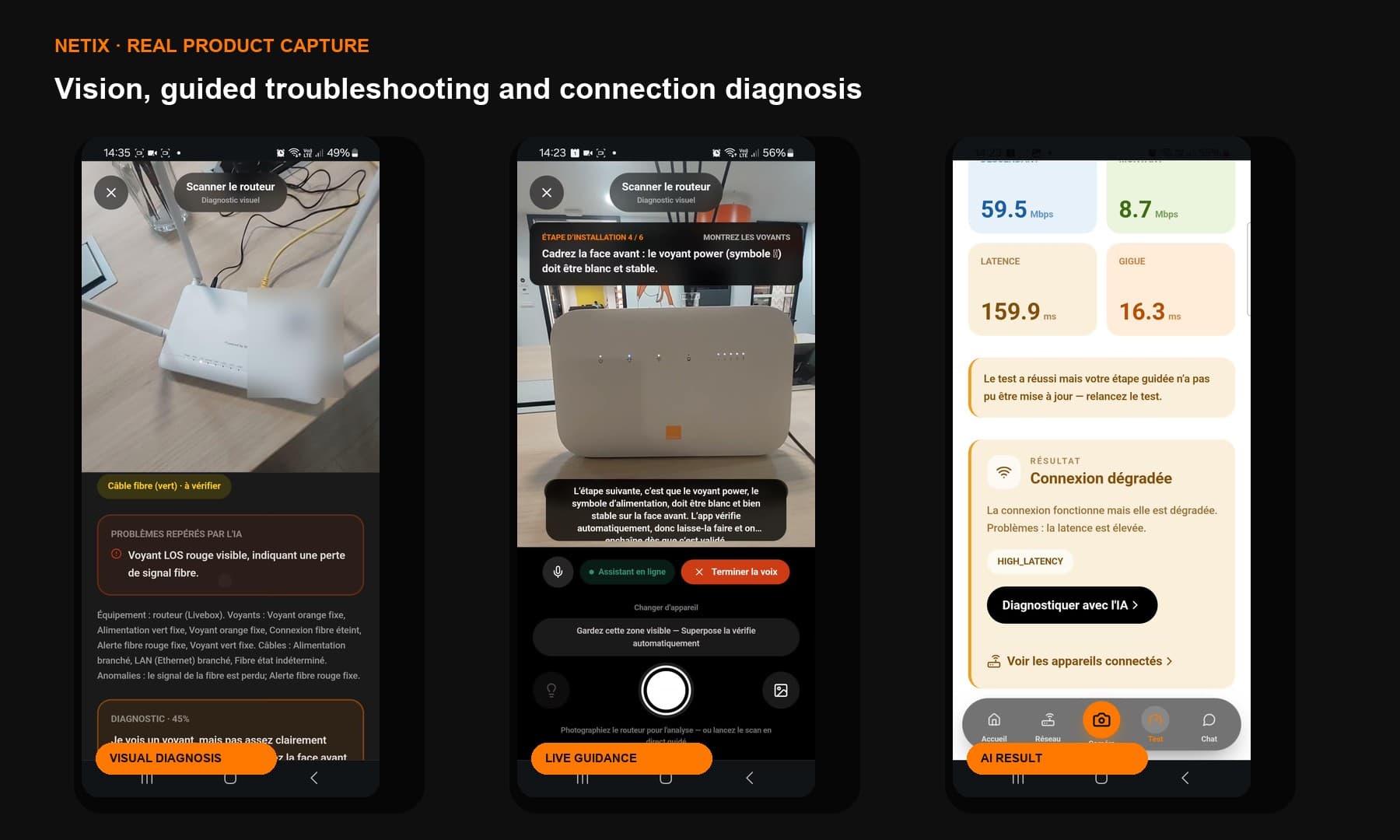
Real product capture from the supplied mobile recordings; router identifiers are blurred.
Real product demo
Netix in 30 seconds
Source audio muted for privacy
Source audio muted for privacy
Assistant for home network diagnosis: computer vision reads router LEDs and cabling, RAG chat grounds troubleshooting in approved knowledge, realtime voice guides the customer in French, English and Darija, and structured AI reasoning interprets network-test evidence.
Netix is a network support assistant built at Orange for customers who lose their home connection. Instead of a long phone call, the customer points a phone camera at the router: a computer vision model reads the status LEDs and the cabling, and a voice assistant walks them through the fix in French, English or Darija.
The detector is an RF-DETR Nano exported to ONNX and combined with OpenCV/HSV analysis with brightness and sharpness quality gates, so it runs in real time on modest hardware. The GenAI layer combines RAG chat over approved device knowledge with realtime multilingual voice. Its strict tool contract limits the assistant to known troubleshooting steps and a support hand-off; it does not improvise unsupported fixes.
When remote guidance is insufficient, the verified implementation prepares the support-ticket hand-off. Completed technician assignment and real network control are outside the claims made here. The stack is Python, FastAPI, ONNX, OpenCV, React and PostgreSQL.
Business figures on this site (support cost per incident, diagnosis time) are projected targets defined with the business team, not measured results yet.
Case-study evidence
From a router image to a grounded next step.
Problem
Home network diagnosis is slow when support starts with a vague verbal description of the router.
My scope
Applied AI engineering across the FastAPI/React architecture, technical decisions, computer vision integration, code reviews and demo delivery in a five-person team.
Verified implementation
RF-DETR Nano ONNX, OpenCV/HSV, image-quality gates, RAG chat, realtime multilingual voice and network-test interpretation connected through FastAPI and React.
Claim boundary
No published accuracy percentage, blink-rate detection or real network control. The support-ticket hand-off is bounded; completed technician assignment is not claimed.
GenAI capability map
One assistant, six connected AI capabilities.
Computer vision
Router, LED and cable evidence through RF-DETR Nano, ONNX and OpenCV/HSV.
RAG chat
Troubleshooting answers grounded in approved device knowledge rather than an open-ended model response.
Live voice
Hands-free guidance with French, English and Moroccan Darija interaction.
AI diagnosis
Visual evidence and network-test results are translated into an explainable next action.
Guided workflow
The customer sees the current installation step, what to photograph and what to verify next.
Support hand-off
When evidence is insufficient, the flow prepares the diagnostic context for human support.
User workflow
- 01
Check the image
Brightness and sharpness gates stop the pipeline before an unreliable frame is treated as evidence.
- 02
Read the router
RF-DETR Nano exported to ONNX detects the relevant hardware; OpenCV/HSV analyses visible LED state and cabling.
- 03
Choose a safe next step
The diagnostic service combines the visual signal with approved device knowledge instead of inventing troubleshooting steps.
- 04
Guide or escalate
The assistant explains the next action in French, English or Darija. If evidence is insufficient, it prepares a support-ticket hand-off.
Architecture
- 01
Camera
Image quality gate
- 02
Vision service
RF-DETR Nano · ONNX · OpenCV/HSV
- 03
Diagnostic API
FastAPI orchestration · device state
- 04
Guidance
RAG · approved knowledge · realtime voice
- 05
Customer UI
React · guided steps · escalation hand-off
The blocks show responsibility boundaries, not deployment topology.
Engineering decisions
Run a small detector
RF-DETR Nano is exported to ONNX for portable inference instead of depending on a heavyweight training runtime in the product path.
Reject weak visual evidence
Brightness and sharpness checks happen before interpretation. A low-quality image should trigger another capture, not a confident diagnosis.
Keep guidance bounded
The assistant reads approved device knowledge and follows explicit tool contracts. When evidence is weak, escalation is safer than improvisation.
Separate product boundaries
Vision, diagnostic orchestration, knowledge retrieval and the React interface remain separate so each part can be tested and replaced independently.
Want the technical walkthrough?
Ask about the vision pipeline, guardrails or product architecture.
Other projects
- ARYA multi-agent recruitment workflow
- CasaMotion real-time mobility data platform
- DocAssist RAG over real-estate documents
- Replenish batch data pipeline for retail procurement
- Radian job intelligence warehouse